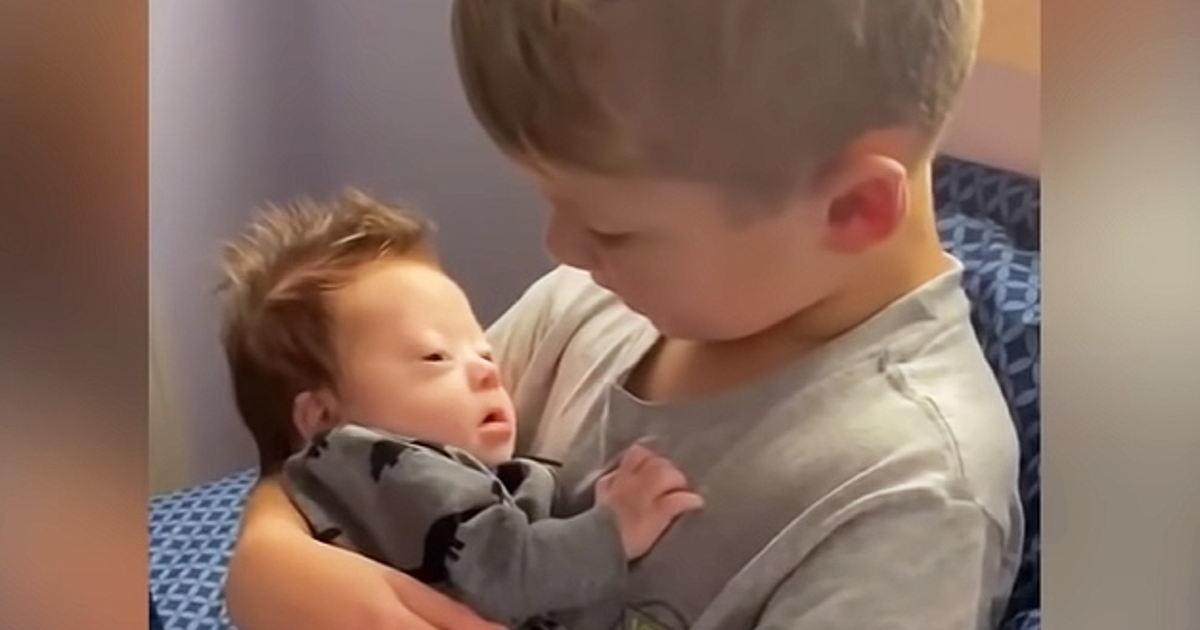

Heartwarming Rendition of “10,000 Hours” by Dan + Shay and Justin Bieber by 6-Year-Old Boy to Calm Infant Brother
In a truly touching moment, 6-year-old Rayce from Arkansas beautifully sang the popular song “10,000 Hours” by Dan + Shay and Justin Bieber to his younger brother Tripp, who was born with Down syndrome. Captured on her phone by their devoted mother, Nicole Powell, the heartwarming scene quickly went viral after being shared on Facebook in January 2020.
At just six weeks old, Tripp had recently returned from the ICU when the video was recorded, as reported by Good Morning America. Throughout his hospital stay, he received unwavering love from his family, including Rayce, who would visit Tripp every day after school and eagerly share details of his daily activities. Powell explained that a strong bond between the brothers formed from the moment Tripp entered the world.
“From the minute (Tripp) was born, Rayce was like: ‘Hand me the baby,'” Powell shared with GMA. “Each day after school he would just talk and talk to Tripp, telling the baby all about his day.”
Rayce would often tell Tripp that the song playing, “10,000 Hours,” was dedicated to him. The meaningful lyrics, emphasizing the importance of investing time to truly understand someone’s heart, perfectly encapsulate the special relationship between Rayce and Tripp, one that is bound to endure throughout their lives.
Spreading Awareness and Destigmatizing Down Syndrome: Powell Shares Rayce’s Inspiring Song
Recognizing the significance of her son Rayce’s heartfelt rendition, Powell felt compelled to share the touching video online, aiming to raise awareness about Down syndrome. In addition to the video, Powell actively worked to challenge the stigmas surrounding Down syndrome, promoting understanding and acceptance.
Don’t miss out on the complete video! Scroll till the end of the article to watch it. 😊

In the Facebook post, Powell reminds people that love does not count chromosomes. She writes:
“Love doesn’t count chromosomes, or as Rayce says, ‘Aren’t we all different?'”
Powell admits to being scared when she first learned about the diagnosis when she was pregnant with Tripp. However, she said that all of her doubts completely disappeared when Tripp was born and she heard him cry for the first time. In a follow-up to the original post on Dec. 30, 2020, Powell urged expectant mothers to “not be afraid” of their baby’s Down syndrome diagnosis:
“To any expecting mother that receives the news that your unborn baby has Down syndrome, do not be scared like I was,” she wrote. “That baby will be such a gift to your family in so many ways and I promise his/her siblings will love them like no other!”
On Tripp’s birthday in November last year, Powell took to Facebook to share her experience of her youngest child’s birth. It turns out that Tripp’s welcome to the world was not easy. Powell was on her way to a routine doctor’s appointment and quite late in her pregnancy, as she explains in her post. She mentions that she had already had problems carrying one of her other children to term, but everything had looked fine so far for her latest pregnancy. But then, during the checkup, the doctor’s reaction to something he saw caused her to worry. Seconds later, she learned that her fears were justified, as the doctor has some unfortunate and urgent news.

“He said, ‘I’ll be right back, let me go grab something.’ He goes back out, I looked over at JJ immediately and told him something was wrong, I just knew it. He walked back in with the nurse and checked again. They both looked at each other and looked at me. I remember instantly getting a lump in my throat. He said, ‘we have to go right now and get this little one out by c section’,” Powell shared.
In a worrisome turn of events, the baby’s heart rate plummeted to a dangerously low level, necessitating immediate action for young Tripp to be delivered promptly. Powell candidly shared her terrifying experience, expressing how her sole concern at that moment was for her baby’s survival, regardless of his Down syndrome diagnosis. “I recall feeling Tripp’s movements and realizing that my only wish was for him to live,” she recounted. Fortunately, little Tripp overcame the ordeal and emerged resilient.
“I remember saying ‘but is he okay?’ And as soon as I said that at 10:55am I heard the sweetest most purest softest cry I’ve ever heard. I’ve never cried with any of my babies (and I love all my babies to death) but his cry was like a sound I had needed to hear for so long to know it would be okay,” Powell continued.
Down syndrome is one of the most common chromosomal abnormalities worldwide. According to a 2010 study by the Department of Pediatrics in the Netherlands, an estimated 1 in 1,000 babies born each year worldwide suffers from Down syndrome. In the U.S., the National Drown Syndrome Society (NDSS) states that, according to the Centers for Disease Control and Prevention, 1 in 700 babies born each year suffers from it.

The exact origins of Down syndrome remain elusive to scientists at present. As our current understanding indicates, Down syndrome is not typically inherited as a hereditary disorder. The majority of children with Down syndrome are born to parents who possess the usual number of chromosomes, with only about 1% of known cases being passed down from one parent.
However, scientific research has established a correlation between a mother’s age and the likelihood of giving birth to a child with Down syndrome. The National Down Syndrome Society (NDSS) reports that a 35-year-old woman has approximately a 1 in 350 chance of having a child with Down syndrome. This probability increases steadily with advancing age, reaching 1 in 100 by the age of 40. By the age of 49, the theoretical chance rises to 1 in 10. With more couples choosing to have children later in life, the number of Down syndrome cases has seen a gradual increase in recent years. Moreover, advancements in non-invasive prenatal screening during early pregnancy have provided more accessible means for detecting Down syndrome without causing discomfort or pain.
While medical science currently lacks a cure for Down syndrome, it is essential to recognize that this condition is not an insurmountable obstacle. Children born with Down syndrome may experience delays in both physical and cognitive development, progressing at a slower pace compared to their typically developing peers. It is crucial to understand that each child with Down syndrome is unique, with a wide range of potential symptoms and developmental stages.
Despite the additional time and effort required, providing care and education to individuals with trisomy 21 is not only possible but also immensely rewarding. In the United States, 40% of individuals with Down syndrome who attend high school successfully graduate or pursue further education. Many go on to secure stable employment and even live independently, although financial management assistance may still be necessary for some.
It is crucial to foster an inclusive society that supports the growth and potential of individuals with Down syndrome, recognizing their capabilities and contributions. With proper care, education, and opportunities, individuals with Down syndrome can lead fulfilling lives and make meaningful contributions to their communities.
Did you find the heartwarming interaction between Tripp and Rayce as touching as we did? We would love to hear your thoughts! Don’t forget to share this beautiful moment with your friends and family too!