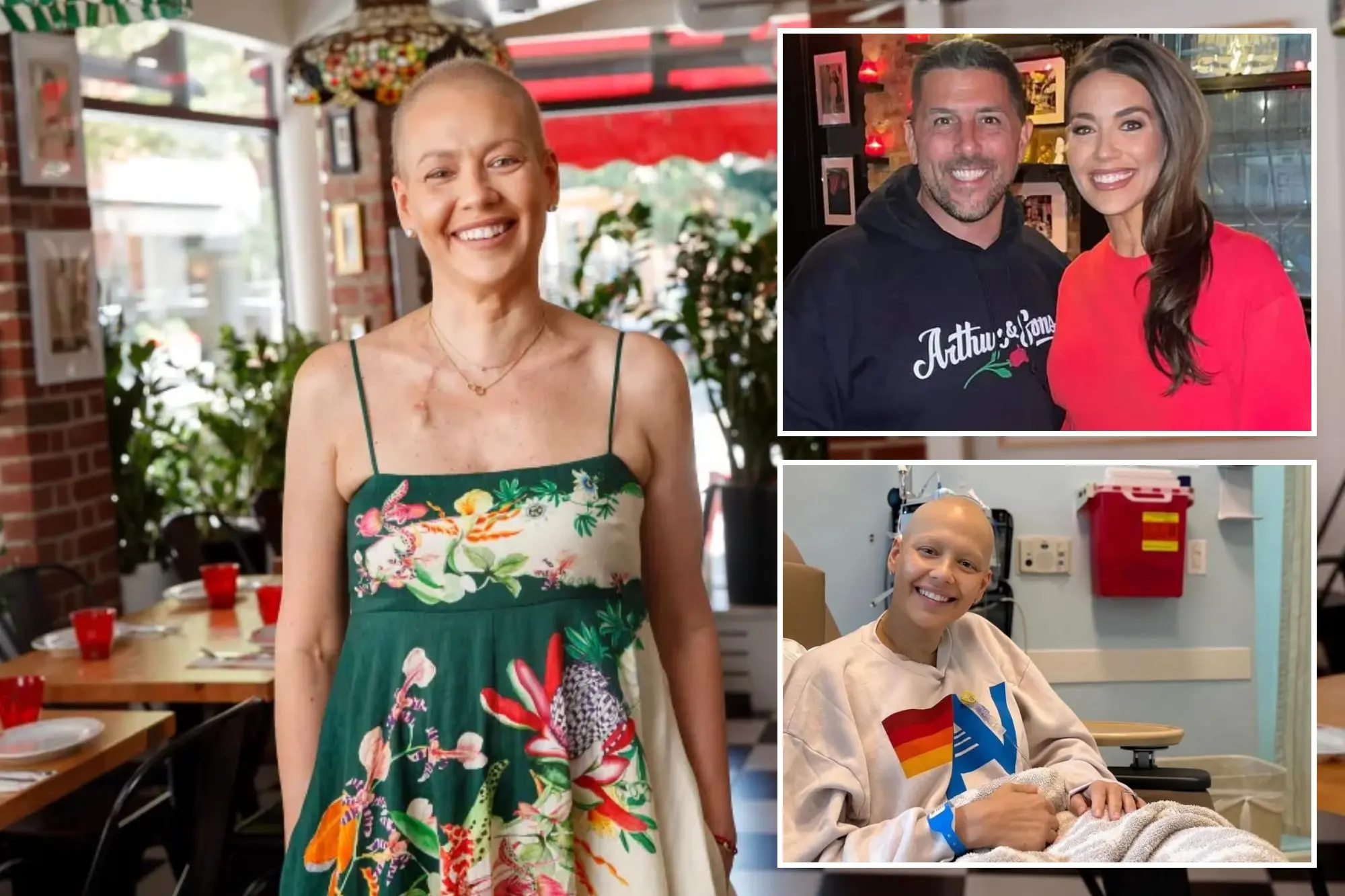

“Florida is doing you well,” guests told Louise Altese-Isidori at the launch party for the new Florida location of her husband’s Manhattan restaurant, Arthur & Sons. The lifelong New Yorker had recently relocated with her family and appeared to be thriving—unaware of the deadly cancer developing inside her.
“Everyone kept telling me I looked amazing,” Altese-Isidori said. “Meanwhile, I was already riddled with cancer.”

Louise Altese-Isidori felt perfectly healthy when she was diagnosed with ovarian cancer that had already spread so extensively she ultimately required the removal of seven organs.
With no symptoms at all, she had no idea the disease had been silently growing and spreading inside her body. Her diagnosis came after she insisted on a screening test that had initially been dismissed by doctors as unnecessary.
Clear test, close call
Altese-Isidori only began monitoring her ovarian health after a fertility specialist recommended a transvaginal ultrasound every six months. Although another doctor downplayed its importance, she opted to continue annual scans.
That decision may have saved her life.
Last October, during a routine gynecological visit, her doctor discovered a large ovarian cyst—despite her feeling completely fine.

Louise Altese-Isidori and her husband, Joe Isidori, were photographed about a month before she received her ovarian cancer diagnosis in December.
Due to the size of the ovarian cyst, her doctor ordered an Ova1 blood test to determine whether it was cancerous. The results came back negative, and a second test a month later also showed no signs of cancer.
Despite the reassuring results, the cyst persisted. Following her doctor’s recommendation, Altese-Isidori ultimately agreed to have her ovaries removed, noting that she did not plan to have more children.
“When he went in, there was cancer in my colon, my liver, it was already in my chest — and I had felt completely fine.”
Louise Altese-Isidori
But when the surgeon scheduled to perform the procedure reviewed her ultrasound, his expression turned serious.
“I don’t want to scare you because your test came back negative, but I don’t like the way things are looking,” he told Altese-Isidori. “I need to get you in as soon as possible to remove your ovaries.”

Louise Altese-Isidori is now on a mission to raise awareness about ovarian cancer, often referred to as the “whisper killer” due to its subtle, hard-to-detect symptoms.
Signing her life away — or saving it
On Dec. 20, Altese-Isidori went into surgery expecting a routine procedure. Instead, doctors made a devastating discovery.
“When he went in, he was able to see that I was filled with cancer,” she said.
A biopsy confirmed Stage 4B ovarian cancer—the most advanced stage—meaning the disease had already spread to distant organs.
According to the Ovarian Cancer Research Alliance, only about 31% of patients diagnosed at this stage survive five years or longer in the United States.

Altese-Isidori and her husband, chef Joe Isidori, were lifelong New Yorkers before recently relocating to Florida.
“I was in complete shock. I kept waiting for someone to say they made a mistake,” she said.
Almost immediately, the couple took action. Within days, she secured treatment at Memorial Sloan Kettering Cancer Center in New York, where she was placed under the care of Dr. Dennis Chi, head of the hospital’s Ovarian Cancer Surgery Section.
“[I thought], ‘That’s going to give me five pounds.’ But I was so disappointed … it was like 10 ounces.”
Louise Altese-Isidori on having seven organs removed
“I feel very lucky in an extremely unlucky situation, because all of my stars aligned,” Altese-Isidori said.
On Jan. 15, she was back on the operating table.

Half of all women diagnosed with ovarian cancer are 63 or older. Altese-Isidori was just 50 at the time of her diagnosis.

Altese-Isidori underwent six rounds of chemotherapy, split between treatment centers in New York and Florida.
As she signed pre-operative paperwork, she told her husband she felt like she was “signing her life away,” initialing every possible worst-case scenario listed in the consent forms.
“The doctor heard me and said, ‘No you’re not, you’re giving me permission to save your life,’” she recalled.
That moment marked a turning point. “It was like something clicked in my mind,” she said. “I got so much strength from his words—it gave me real motivation.”

Life goes on — seven organs lighter
Altese-Isidori’s incision scar stretched from her abdomen upward along her torso.
“When he went in, there was cancer in my colon, my liver—it was already in my chest—and I had felt completely fine,” she said.
Dr. Chi removed her spleen, appendix, gallbladder, uterus, ovaries, fallopian tubes, and the lining of her stomach, all of which were affected by cancer.
After losing seven organs, Altese-Isidori couldn’t help but wonder if it had changed her weight.
“I thought, ‘That’s going to give me five pounds,’” she said. “But we looked it up and added it all together—it was like 10 ounces. It was ridiculous,” she added with a laugh.

Being separated from her 8-year-old son, Roman, during treatment was one of the most difficult parts of Altese-Isidori’s cancer journey.
Dr. Chi was able to spare part of her liver and colon, but she required a colostomy bag attached to a small opening in her lower abdomen to allow waste to exit her body.
She remained in the hospital for 18 days, during which she practiced what she called “mirror talks” to stay mentally strong. “I would tell myself, ‘Alright, enough already. Enough of the pity party. We have a lot left to do,’” she said.
Chemotherapy began a week later and, while she described it as “mental warfare,” she said she ultimately had a relatively manageable experience through six rounds of treatment split between Memorial Sloan Kettering and the Miami Cancer Institute in Florida.

Altese-Isidori’s diagnosis came after she requested a transvaginal ultrasound, a screening test not typically included in routine women’s health checkups.
Aside from fatigue, body aches, and complete hair loss, she prepared herself for severe side effects—but was surprised when they did not fully materialize.
“There wasn’t anything really major compared to what I thought it would be,” she said, crediting regular IV hydration every few days for helping her through treatment.
Over time, she adapted to life with a colostomy bag, and gradually began to regain a sense of normalcy.
“I was wearing sweatpants in the beginning, but eventually I said, ‘Screw this, I’m getting dressed up,’” she said. Soon after, she was attending doctor’s appointments in her favorite dresses and heels.

Altese-Isidori received hydration therapy at Sollis Health during her chemotherapy treatments.
A new chapter begins
Recently, she underwent surgery to remove her colostomy bag. Soon after, she received encouraging news: her CA-125 test—used to monitor a protein often elevated in ovarian cancer patients—had returned to normal levels.
“I’m technically in remission,” she said.
She celebrated with a “remission cake” surrounded by loved ones, including her 8-year-old son, Roman, and her 94-year-old mother.
“My hair is starting to grow back, and I feel good,” she said, though she admitted she remains cautious. “I think I’ll always be in fight mode.”
“I don’t want to let my guard down. I feel like there are evil eyes lurking somewhere watching me,” she added.
According to the Ovarian Cancer Research Alliance (OCRA), recurrence rates for Stage 4 ovarian cancer can be as high as 95%.

For patients with Stage 4 ovarian cancer, the risk of recurrence can be as high as 95%.
“To think that at seven months I won and I beat it for life is silly. But today I’m OK,” she said, noting she now takes a daily PARP inhibitor pill, a targeted therapy designed to help delay or prevent cancer’s return.
“I want to redefine the face of stage 4 cancer,” she said. “I want people to know you can still have a full life—even with a colostomy bag.”
“It’s important to remember there’s a lot of hope,” she added. “It’s not a dead end.”

Her husband is the owner of Arthur & Son’s, a popular old-school Italian restaurant with locations in Manhattan and the Hamptons.
“Maybe I took one for the team [and] now there’s a woman behind me who doesn’t have to,” she said.
Although Altese-Isidori had no symptoms, ovarian cancer often presents with subtle warning signs that are easy to overlook—earning it the nickname “the whisper killer.”
Common symptoms include bloating, fatigue, feeling full quickly, changes in bowel or bladder habits, and pelvic, back, or abdominal pain.
“The biggest thing is persistence,” said Jennifer McGrath, executive director of Hearing the Ovarian Cancer Whisper, a nonprofit focused on raising awareness. “If something lasts longer than a few weeks, you’ve got to get in to see a doctor.”

Altese-Isidori said she is determined to live a full life following her battle with ovarian cancer.
Jennifer McGrath encourages women—especially those with a family history—to ask their doctors about a CA-125 blood test. While it is typically used after diagnosis, she says it can help establish a personal baseline that may be useful later.
Altese-Isidori and McGrath also recommend annual transvaginal ultrasounds, even for women who are not postmenopausal—the group most commonly affected by ovarian cancer.
“Over the last 10 years, a lot of younger women are getting it,” McGrath said. “But it’s not necessarily a cancer doctors are trained to screen for—you have to ask for it.”
According to the American Cancer Society, a woman’s lifetime risk of developing ovarian cancer is about 1 in 91. In 2025, an estimated 20,890 women will be diagnosed in the U.S., and about 12,730 will die from the disease.