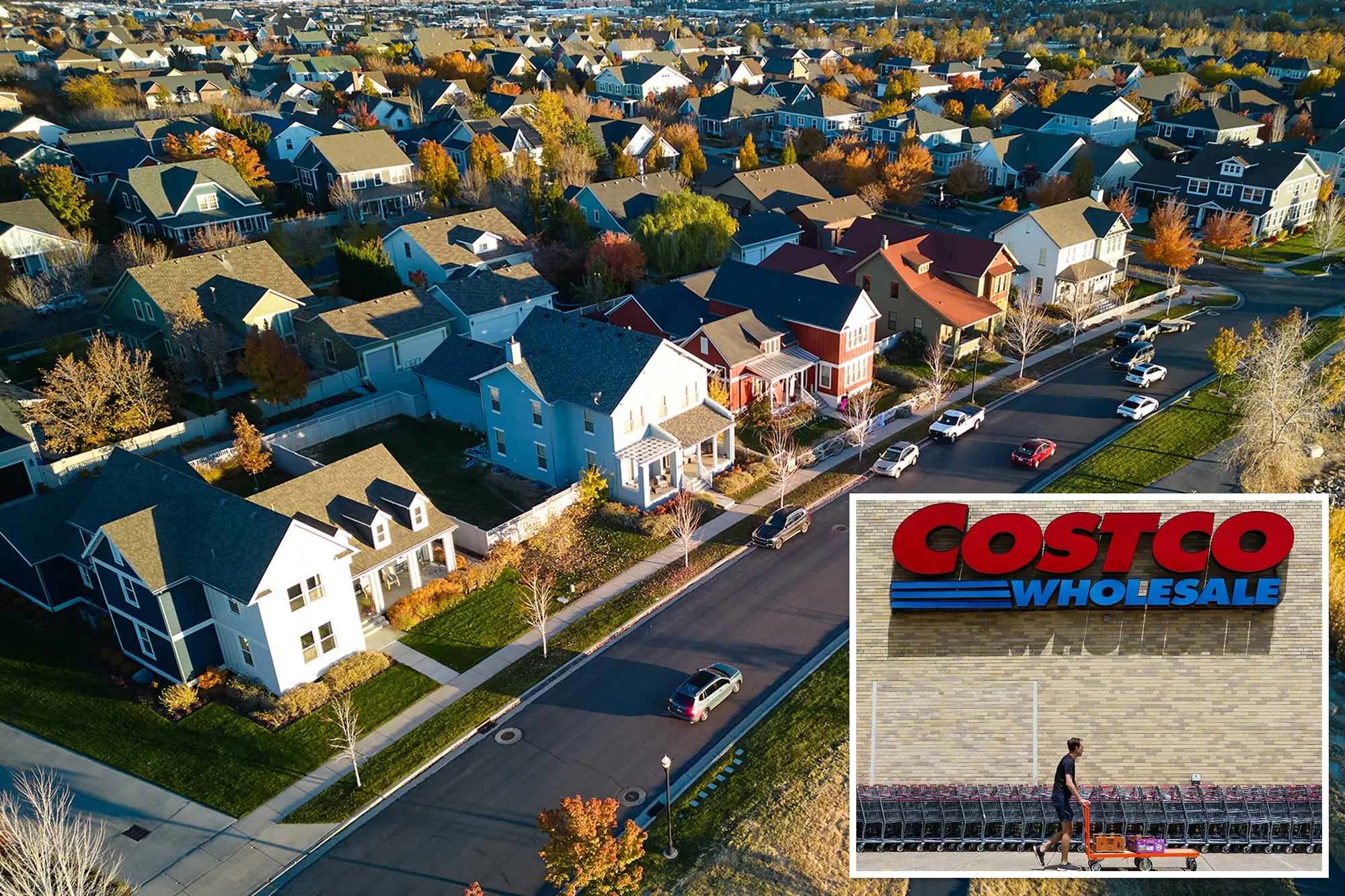
Forget top-rated schools, sprawling backyards and gourmet kitchens. For a growing number of American homebuyers, one of the most desirable neighborhood perks is having a Costco just minutes away.
The warehouse retail giant has become such a sought-after amenity that house hunters are increasingly weighing proximity to their nearest location when deciding where to buy a home — a trend known as the “Costco effect.”
According to USA Today, real estate agents say the ideal distance is a five- to 15-minute drive — close enough for convenient shopping trips, but far enough to avoid traffic congestion, delivery trucks and crowded parking lots.

Living near a Costco is becoming an increasingly attractive selling point for American homebuyers — and sellers are taking notice.
A Zillow analysis found that about 3% of active home listings across 606 ZIP codes with a Costco specifically mention the warehouse retailer in their property descriptions, highlighting its convenience as a neighborhood perk.
In Pensacola, Florida, one listing for a three-bedroom home touted its location just 2.6 miles from the city’s first Costco, alongside easy access to downtown attractions and nearby beaches.
Meanwhile, in Austin, Texas, Nice Move Realty broker Sean McCormack has taken the trend a step further, adding Costco proximity to his home-search tools so prospective buyers can browse properties based on their distance from the popular warehouse chain.


For some homebuyers, living near Costco isn’t just a bonus — it’s a deciding factor.
A Redfin agent in Kansas City recalled working with a family relocating from Colorado who specifically wanted a home close to the warehouse retailer.
For Adam Staley, a Kansas City, Missouri, resident who shops at Costco at least four times a week, proximity to the store played a major role in choosing his family’s rental home.
Staley told USA Today that the property was just five blocks from Costco, allowing him to reach his favorite shopping spot in only three minutes.
But that convenience came to an abrupt end when the location closed to be converted into a Costco Business Center, forcing Staley to travel roughly 25 minutes to reach the nearest traditional warehouse.
Beyond the convenience of bulk shopping, living near Costco could also carry financial benefits for homeowners.

Living near a Costco may offer more than just shopping convenience — it could also increase a home’s value, although the financial benefits vary by location.
As The Post previously reported, research from the Vancouver School of Economics examining Costco openings across the US between 2002 and 2020 found no statistically significant effect on surrounding home values overall.
However, the study revealed notable gains in certain markets. Homes within five miles of a new Costco in counties with above-average population density saw property values climb 7.9%, while homes in higher-income counties experienced a 5.2% increase in the 2½ years following a warehouse opening.
The findings suggest that Costco’s impact on real estate prices largely depends on neighborhood demographics and local housing market conditions.
Still, living near the retail giant isn’t without its drawbacks. While quick access to bulk groceries, discounted gas and everyday essentials can make a location more desirable, being too close to a busy warehouse can also bring heavy traffic, congested streets, packed parking lots and a steady stream of delivery trucks.