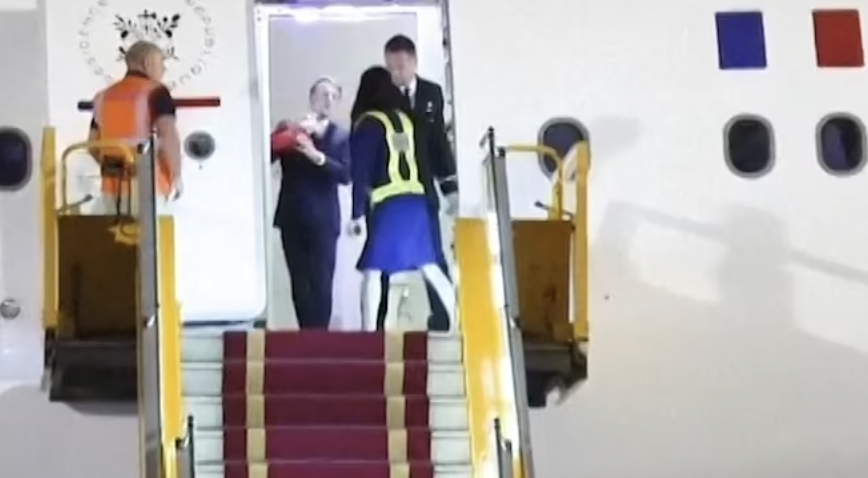

Emmanuel Macron’s office has acknowledged that his wife, Brigitte, made physical contact with him during a dispute, following the release of footage showing the First Lady appearing to push his face aside as they disembarked from a plane in Vietnam.
The incident, captured in a video by the Associated Press in Hanoi on Sunday evening, shows the French President emerging from the aircraft. Moments later, Brigitte Macron’s arms appear from the left side of the doorway as she places both hands on his face and gives it a noticeable shove.
The President appears momentarily startled by the gesture but quickly regains his composure, turning to wave through the open aircraft door.
Brigitte Macron remains out of full view, obscured by the plane’s structure, leaving her facial expression and body language unseen.
The couple then descend the staircase for an official welcome by Vietnamese dignitaries, though Brigitte notably declines to take her husband’s offered arm.
Initially, the Élysée Palace denied the authenticity of the footage. However, it was later confirmed as genuine.
A close associate of President Macron later characterized the incident as a harmless “squabble” between the couple.

Footage captured by the Associated Press in Hanoi on Sunday evening shows the door of Macron’s plane opening to reveal the French President.

Brigitte Macron’s arms emerge from the left side of the open doorway as she places both hands on her husband’s face and gives it a firm push.

The President appears momentarily startled but quickly regains his composure and turns to wave through the open door.

The couple then proceed down the staircase to receive an official welcome from Vietnamese officials, though Brigitte Macron pointedly declines to take her husband’s offered arm
An Élysée official downplayed the incident, denying it was indicative of any disagreement between the couple, who have been married since 2007. “It was a moment when the President and his wife were relaxing one last time before the start of the trip by having a laugh,” the official said, describing it as “a moment of closeness.”
Another member of the presidential entourage also minimized the significance of the moment. “It was a time for the President and his wife to decompress before the start of the visit, sharing a lighthearted moment,” the source told reporters. “It’s a moment of togetherness. Nothing more. But that hasn’t stopped conspiracy theorists from seizing on it.”
The source attributed much of the negative reaction online to pro-Russian social media accounts known for routinely targeting the French President. The video clip quickly spread across the internet, gaining traction particularly among accounts hostile to Macron.
President Macron later commented that this was not the first time recently that footage involving him had been misrepresented. He referred to those distorting such content as “crackpots.”
Earlier this month, the French government strongly denied a fabricated claim that President Macron had concealed a bag of cocaine while posing for a photo with UK Labour leader Keir Starmer and Germany’s Friedrich Merz. The photo was taken aboard a train en route from Poland to Ukraine, where the trio met with President Volodymyr Zelensky in a show of support and to increase pressure on Russia for a ceasefire.


Vietnam marks the first stop on President Macron’s nearly week-long tour of Southeast Asia, during which he aims to present France as a reliable alternative to both the United States and China

French President Emmanuel Macron (left) and his wife Brigitte Macron attend a ceremony at the Temple of Literature in Hanoi on May 26
Pro-Russian online commentators were quick to spread conspiracy theories claiming that a white object on the table was drugs. However, the French government promptly clarified that the item was, in fact, a tissue.
Macron’s visit to Vietnam—the first by a French president in nearly a decade—comes as he seeks to strengthen France’s influence in its former colony.
Vietnam, with its export-driven economy, has made concessions in trade talks with the United States to avoid facing tariffs of up to 46%. Meanwhile, the European Union has expressed concerns that Vietnam’s increased purchases of American goods could come at the expense of European markets.
Last Friday, US President Donald Trump threatened to impose 50% tariffs on imports from the European Union but softened his stance two days later by extending the deadline for trade talks between Washington and Brussels to July 9.
Vietnam is the first stop on Macron’s nearly week-long tour of Southeast Asia, where he plans to promote France as a reliable alternative to both the United States and China.

Far-right propagandists and Russian keyboard warriors were behind the recent allegations.
During his nearly week-long Southeast Asia tour, President Macron will also visit Indonesia and Singapore.
On the first day of the tour in Hanoi, Macron emphasized the importance of preserving a world order “based on law.” Speaking alongside his Vietnamese counterpart, Luong Cuong, Macron stressed that a rules-based international system is essential “at a time of both great imbalance and a return to power-driven rhetoric.”
The French President signed over a dozen agreements covering defense, nuclear energy, and trade. Notably, deals were finalized with Vietnamese budget airline VietJet and Airbus for the purchase of 20 A330-900 aircraft.
Macron also paid tribute at a Hanoi war memorial to those who fought against French colonial rule. He held meetings with Prime Minister Luong Cuong and Communist Party General Secretary To Lam.
Additionally, Macron visited the 11th-century Temple of Literature, located in the heart of Hanoi.


France and Vietnam’s “sovereignty partnership” could become the cornerstone of France’s strategy in the Indo-Pacific, President Macron stated.
Highlighting France’s commitment to upholding international maritime law, Macron referenced the deployment of the French carrier strike group to the South China Sea in early 2025 as a clear demonstration of this resolve.
While China and Vietnam have a longstanding maritime agreement governing the Gulf of Tonkin, they remain in dispute over competing claims in the South China Sea, particularly around the Spratly and Paracel Islands.
Macron emphasized that France would support Vietnam in several key sectors, including critical minerals, high-speed rail, civil nuclear energy, and aerospace. He also underscored a focus on partnering with Vietnam to help transition away from coal power by expanding capacity in renewable energy and civil nuclear power.
This marks Macron’s first visit to Vietnam since assuming office in 2017.
France and Vietnam share a comprehensive strategic partnership—the highest level of diplomatic ties Vietnam holds—also maintained with countries such as Russia, China, and the United States.