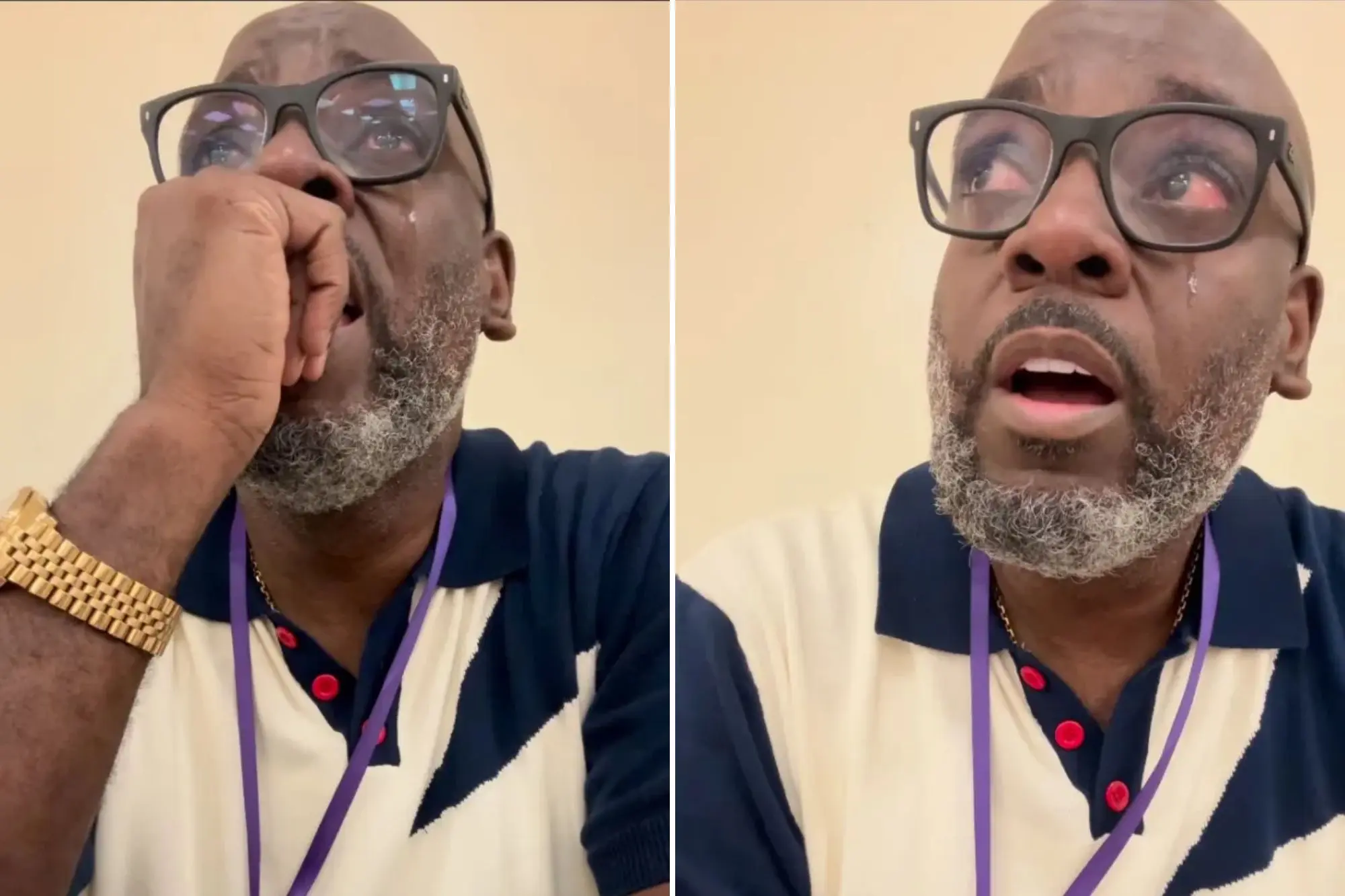

A Texas high school teacher was overcome with emotion and broke down in tears in front of his students after discovering that many of the seniors in his class struggled to complete a basic writing assignment.
Darius Williams, a teacher at Wheatley High School in the Houston Independent School District, said he became emotional just two days into the new school year after witnessing his students’ difficulties with reading and writing.
“I just finished a three-hour class, and I literally broke down in the middle of class,” Williams revealed in an Instagram video recorded during his lunch break on Tuesday.

Houston high school teacher Darius Williams broke down in tears on August 11, 2026, after discovering that some of his senior students struggled to complete a basic writing assignment.
Williams, a Career and Technical Education (CTE) staff member working under the New Education System (NES), said he asked his class of high school seniors to read two paragraphs and complete a sentence he had already partially written for them. However, he was shocked when the students were unable to fill in just four missing words.
“I basically completed the sentence for them,” Williams explained. “These are 17- and 18-year-old kids, and they couldn’t fill in four words. Four words!” he exclaimed.
“I gave them the scenario, we annotated together. I gave them the answers before we even had the problem and they couldn’t do it. I don’t know, I simply don’t know where the problem is,” he said, expressing his frustration.
Overwhelmed by the experience, Williams became emotional as he reflected on the literacy challenges facing his students.
“This is only day two, and I have seniors who simply cannot read and seniors who cannot write. They cannot write,” Williams said tearfully.

Williams said he became overwhelmed during his first class on the second day of school after witnessing the extent of his students’ struggles with basic reading and writing skills.
In the emotional video, the Houston teacher appeared visibly distressed, with reddened eyes and tears rolling down his cheeks. He explained that while his students could communicate verbally, think critically, and defend their arguments, they struggled to express those same ideas in writing.
“Our young black men, our young brown men, our young black girls, and our young brown girls,” Williams said before breaking down in tears and abruptly ending the video.
However, his emotional revelation sparked mixed reactions online, with some critics questioning his teaching qualifications and whether he was qualified to assess his students’ literacy challenges.
In response to the criticism, Williams, who also works as a cooking content creator, highlighted his academic achievements and professional credentials.
He revealed that he had earned his second bachelor’s degree from Berklee College of Music in April and said he was pursuing a master’s degree in Curriculum and Instruction at the American College of Education.
Williams also pointed to several professional certifications he holds, including credentials issued by the state of Texas and the Texas Education Agency, as he defended his qualifications as an educator.


Williams also faced criticism after sharing the emotional video, with some social media users questioning his teaching credentials and whether he was qualified to comment on his students’ literacy struggles.
Addressing the backlash in a follow-up Instagram video, Williams defended his professional qualifications and challenged his critics to experience the realities of teaching firsthand.
“I have all of my certifications lined up,” Williams stated.
“For those of you who may have an issue or problem with me teaching young adults, take the charge, you do it. You get certified, walk into these high schools, you get a classroom, you stand in front of 22 kids each period and let me see how well you do,” he said.
Williams’ emotional breakdown also came amid broader concerns about literacy levels among American students. Just days earlier, reports revealed that more than half of New York City students in grades three through five had failed to demonstrate proficiency on English Language Arts tests during the previous school year, raising further questions about reading and writing skills in U.S. schools.

Meanwhile, preliminary data released by the New York State Education Department highlighted concerns about students’ reading and writing abilities.
According to the results, 57% of third graders, 52% of fourth graders, and 57% of fifth graders failed to meet English Language Arts (ELA) proficiency standards during the 2025–2026 academic year.
The report also revealed that just 48% of students in grades four through eight achieved proficiency in English Language Arts, representing what the department described as a significant five-percentage-point decline from the previous year.