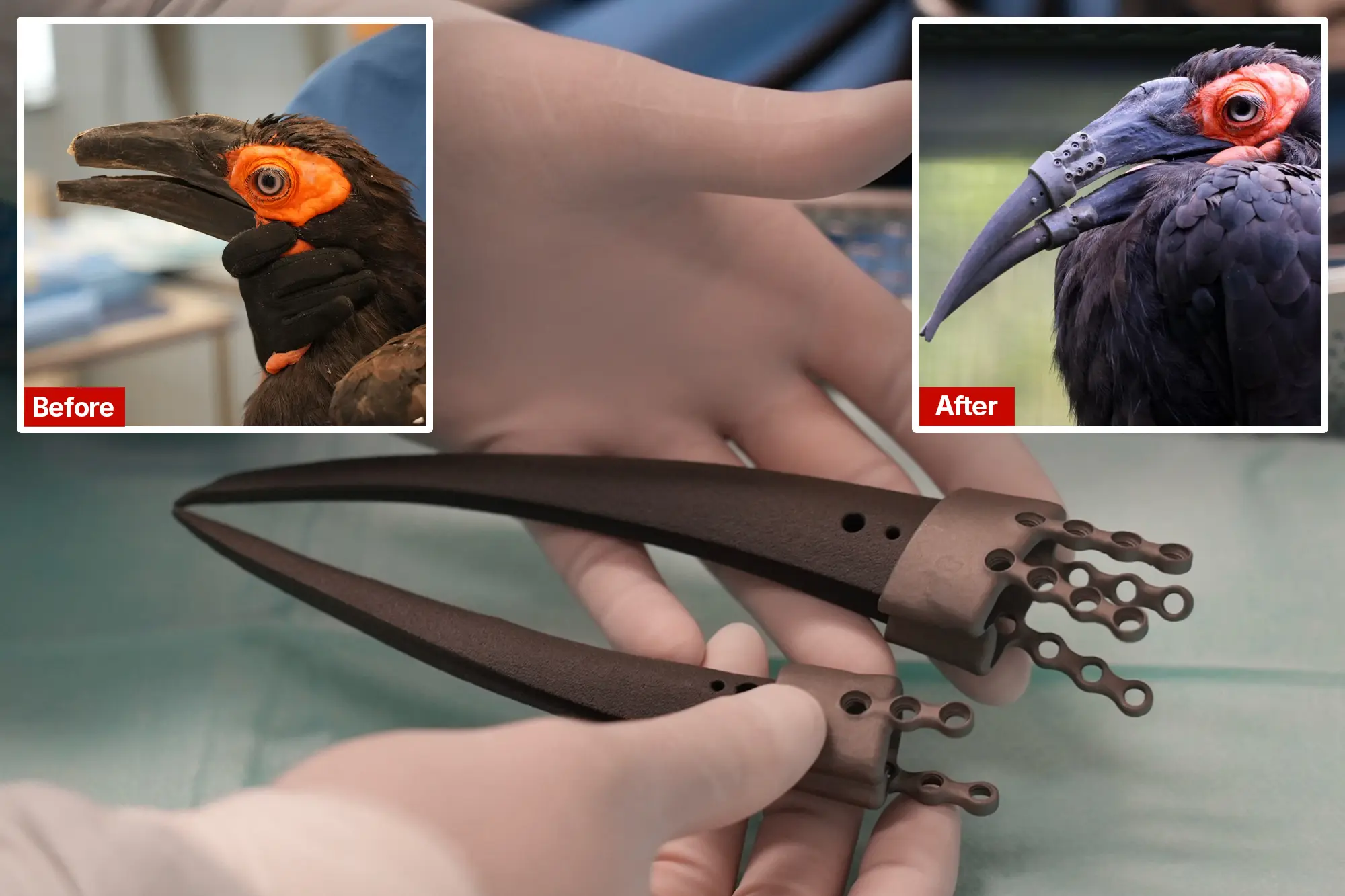
A southern ground hornbill at Artis Zoo in Amsterdam has made history as the first bird in the world to receive two 3D-printed prosthetic beaks. The injured bird underwent a groundbreaking procedure after both its upper and lower beaks broke, making eating difficult and affecting its quality of life. Surgeons fitted the bird with custom-made plastic beak replacements, carefully securing them with screws to restore their function.

A young male southern ground hornbill at Amsterdam’s Artis Zoo has become the first bird in the world to receive both upper and lower 3D-printed beak prostheses. The bird’s damaged beaks had made it difficult to eat and care for itself, significantly affecting its quality of life.
To help the hornbill regain its independence, Artis Zoo partnered with veterinary specialists at Utrecht University in the Netherlands to develop custom-made artificial beaks.
While other birds have received single beak prostheses, this groundbreaking procedure marks the first documented case of a bird receiving replacements for both its upper and lower beaks, according to the zoo.

The hornbill’s upper and lower beaks were both broken, prompting veterinary experts at Utrecht University to create two custom 3D-printed replacements. Using fragments of the bird’s original beak alongside detailed scans of its head and remaining beak structures, the team designed prostheses that were surgically attached by veterinarians Bjorn Meij and Lucinda van Stee.
Zoo officials initially worried that the bird might struggle to adapt to the artificial beaks because the plastic replacements would have no sensation. As a precaution, the prostheses were secured with removable screws in case the bird rejected them or stopped eating.
However, the procedure proved promising almost immediately. Remarkably, the hornbill began using its new beaks on the very same day as the surgery.
The hornbill adapted remarkably quickly to its new 3D-printed beaks, despite needing to adjust to their different shape and added weight. According to Artis Zoo, the bird appeared comfortable almost immediately after surgery. By the following morning, it was already picking up a mouse from the ground and eating independently using its artificial beaks.
Veterinary specialists are now closely monitoring the hornbill’s recovery, feeding habits and overall behavior to assess the long-term success of the procedure. As a precaution, the team has also produced spare prosthetic parts that can be fitted if either of the plastic beaks becomes damaged or breaks.
The zoo hopes the innovative treatment will continue to improve the young bird’s quality of life while providing valuable insights into the use of 3D-printed prosthetics in veterinary medicine.

Veterinary specialists at Utrecht University designed the hornbill’s two 3D-printed beak prostheses using fragments of its original broken beaks, detailed head scans and measurements of the remaining beak structures.
Beyond helping the bird eat and care for itself, Artis Zoo is also studying how the artificial beaks may affect its relationship with its female partner. Researchers had previously observed the pair’s behavior and now hope to identify any changes in their interactions following the surgery.
The zoo is particularly interested in whether the hornbill’s restored beak function could improve the couple’s chances of breeding successfully. A healthy, functional beak plays an important role in courtship, bonding and caring for offspring.
Zoo officials hope the breakthrough will not only improve the male hornbill’s quality of life but also allow the pair to raise chicks together in the future.