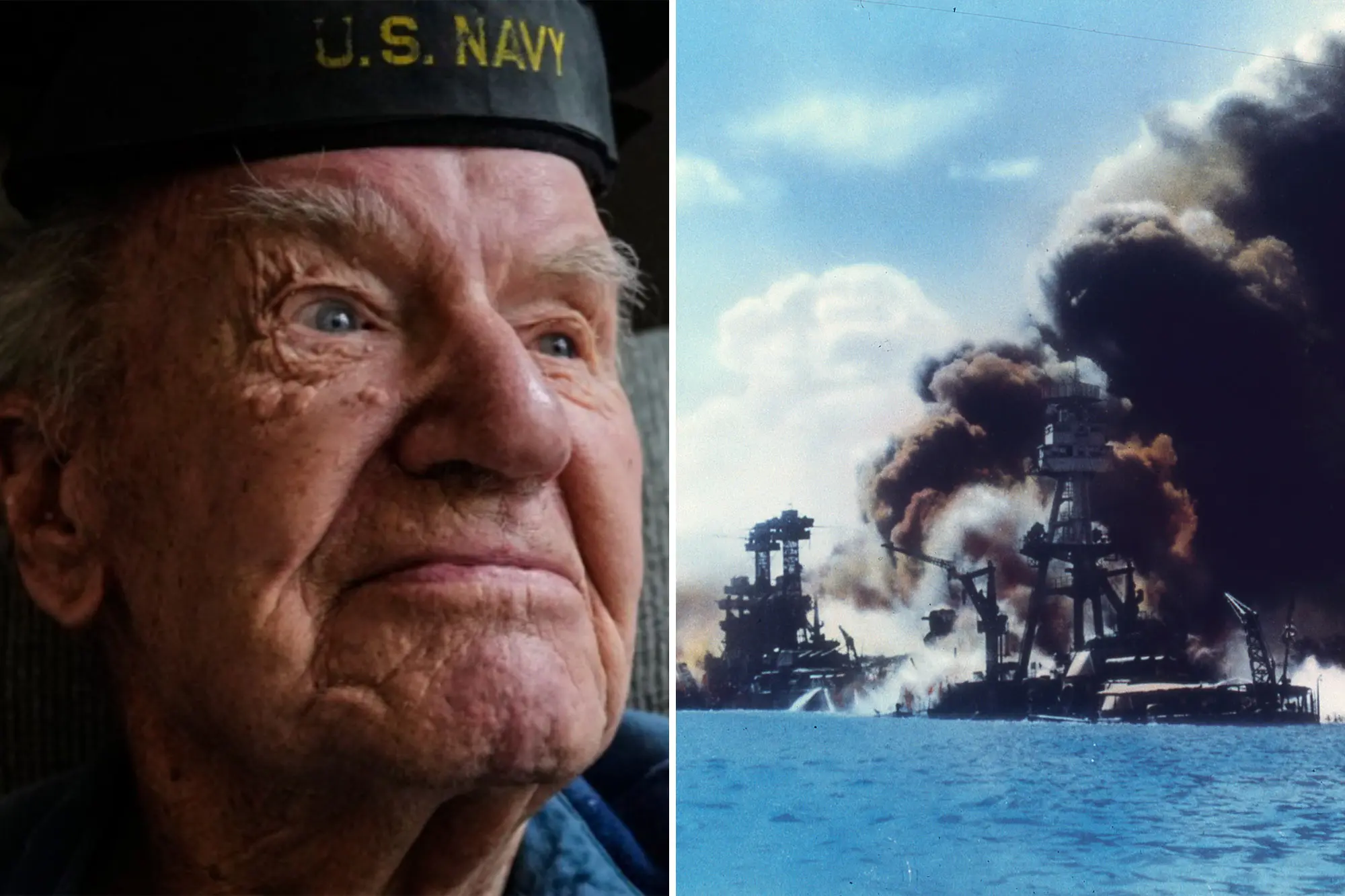
BOSTON — Freeman Johnson, one of the last surviving veterans of the attack on Pearl Harbor and the oldest among them, has died at age 106.
Johnson passed away Saturday at his home in Centerville, Massachusetts, his daughter Diane Johnson confirmed.
“He’s going to be up there with all of his friends and family and my mom,” said Diane, 72. “It’s going to be a hell of a Thanksgiving.”

Pearl Harbor survivor Freeman Johnson, who witnessed the historic attack while serving aboard the USS St. Louis, has died at age 106.
On Dec. 7, 1941, Johnson was among an estimated 87,000 military personnel stationed on Oahu. At the time of the Japanese surprise attack, he was working below deck on a boiler aboard the USS St. Louis.
In a May 2026 interview with The Associated Press, Johnson recalled that he neither saw nor heard the attack as it unfolded. He also missed the sound of his fellow sailors firing anti-aircraft guns at Japanese planes, including one torpedo aircraft they managed to shoot down.
“While all the rigamarole was going on topside, I was inside a steam drum. Couldn’t see anything, absolutely nothing,” Johnson said. His position aboard the ship was known as a firefighter.
By the time Johnson made his way above deck, the USS St. Louis, a light cruiser, had already evaded Japanese midget submarines and safely headed out into the Pacific.
“We were way out to sea, way out. You couldn’t see any land at all. All you saw was ocean,” he recalled. “I was just a sailor, just a swabbie, I was not an officer. They don’t tell you anything if you don’t need to know. And I didn’t need to know it. So they tell you nothing.”
The number of surviving Pearl Harbor veterans had dwindled to roughly a dozen following the December 2025 death of Ira “Ike” Schab, who died at age 105.

Johnson was the oldest surviving veteran of the attack on Pearl Harbor.
Although he did not witness the assault that killed more than 2,400 Americans and brought the United States into World War II, Johnson went on to experience several other significant moments in the conflict.
He helped commission the USS Iowa and later recalled the battleship’s preparations in November 1943 to transport President Franklin D. Roosevelt to the Tehran Conference, where he was scheduled to meet with British Prime Minister Winston Churchill and Soviet leader Josef Stalin.
The battleship was specially outfitted for the presidential voyage, including two elevators and a bathtub. To make the vessel lighter as it traveled down the Potomac River to pick up Roosevelt, ammunition and much of its fuel were removed. The supplies were reloaded before the ship set out to sea.